Spatial240
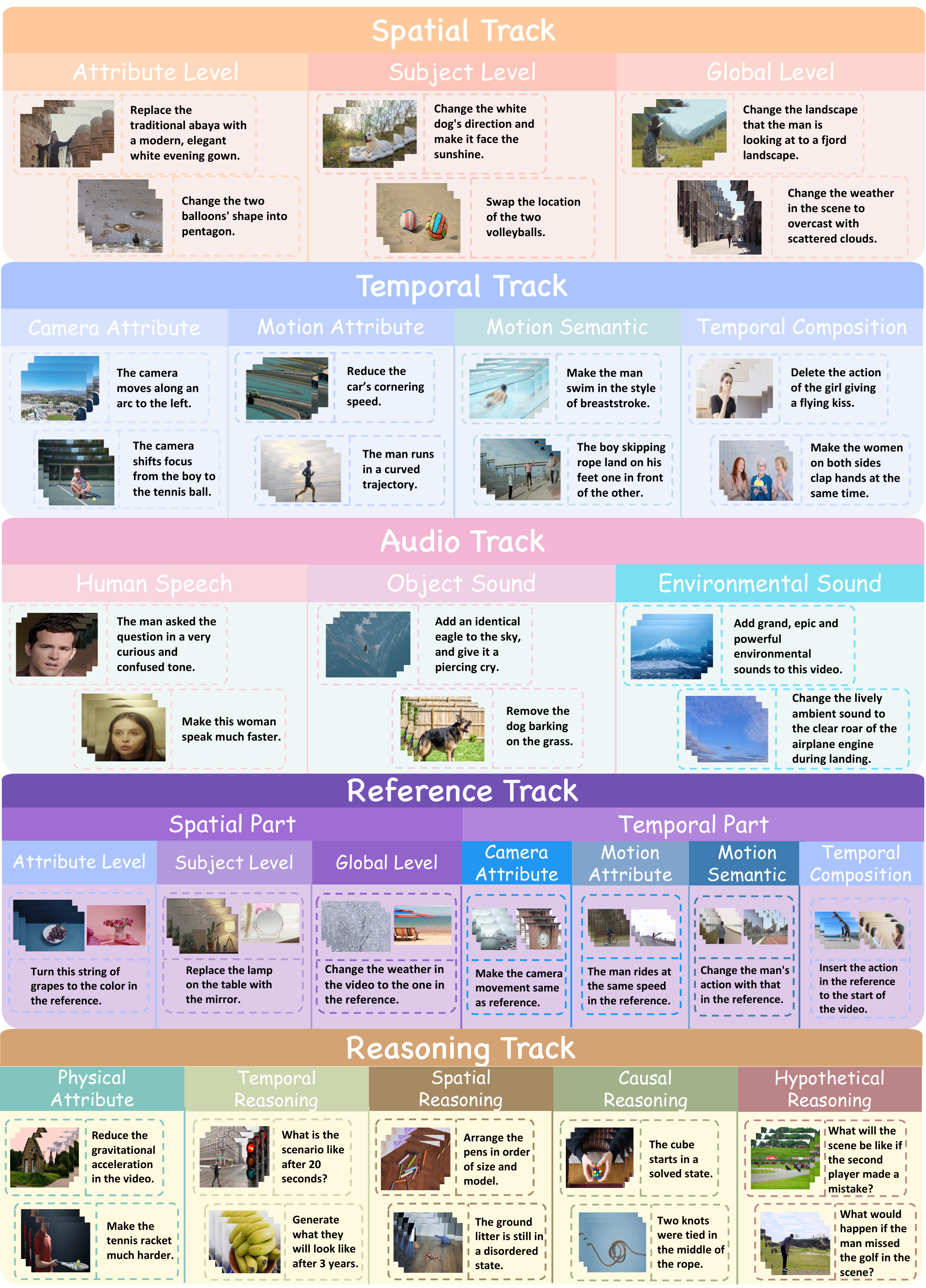
Attribute, subject, and global scene editing
Fine-grained visual changes for color, texture, material, object-level operations, relighting, weather, and style.
Instruction-based video editing benchmark
A comprehensive benchmark for evaluating whether video editing models can follow explicit and implicit instructions across spatial, temporal, audio, reference-based, and reasoning scenarios.
Why this benchmark
Existing IVE benchmarks are often narrow and image-editing centric. OmniEdit-Bench expands evaluation to video-specific dimensions such as temporal dynamics, audio alignment, reference conditioning, and implicit reasoning.
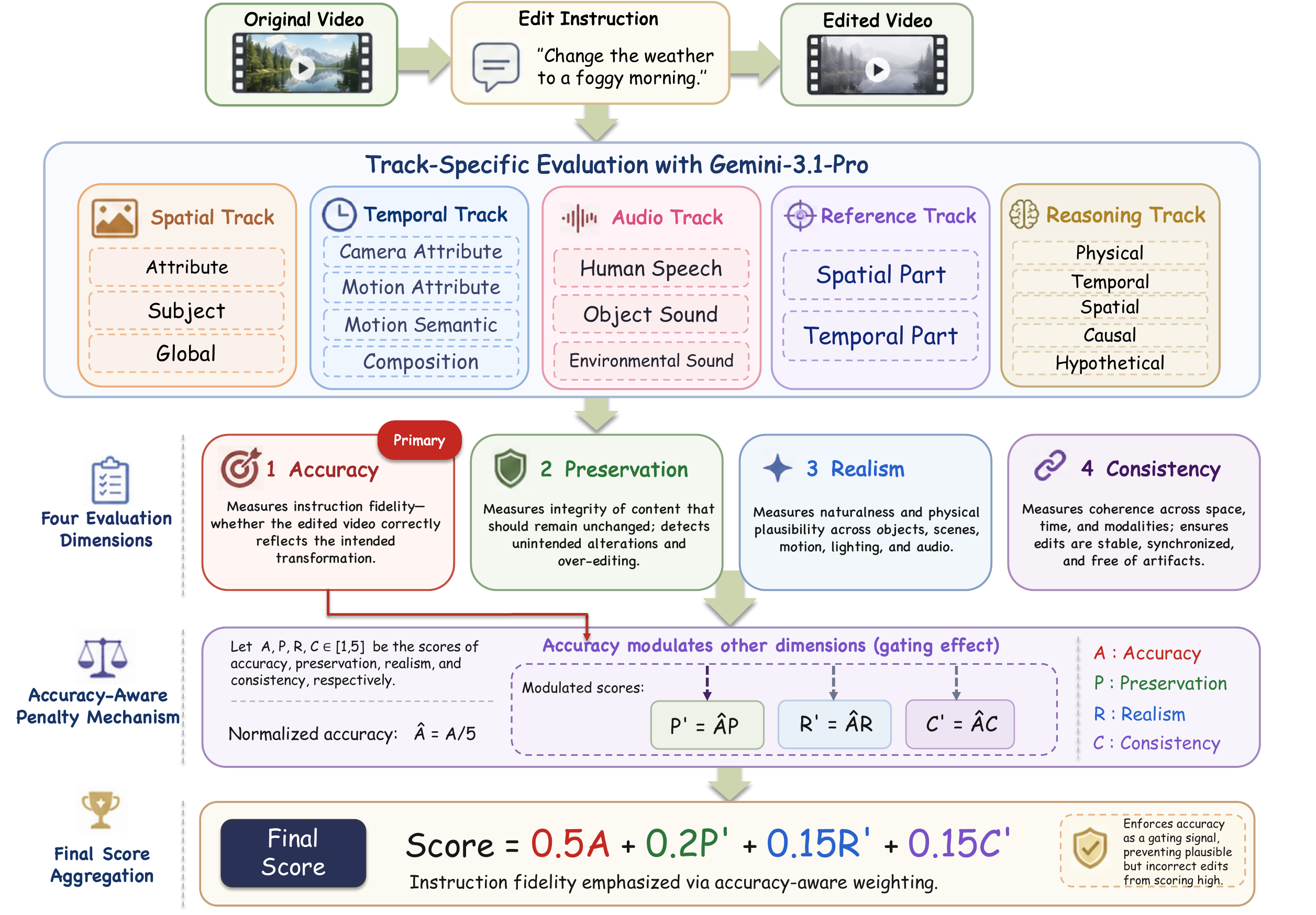
The benchmark also treats instruction fidelity as central. Its accuracy-aware scoring mechanism reduces preservation, realism, and consistency scores when the edit itself is incorrect.
Benchmark taxonomy
Fine-grained visual changes for color, texture, material, object-level operations, relighting, weather, and style.
Video-native edits that require stable trajectories, coherent object dynamics, semantic motion changes, and action-level composition.
Reference-conditioned edits that test whether models can align generated outputs with external visual and motion signals.
Multimodal editing tasks for speech content and tone, object sounds, and environmental audio aligned with visual events.
Physical, spatial, temporal, causal, and hypothetical reasoning edits where the desired outcome must be inferred.
Evaluation framework
OmniEdit-Bench decomposes editing quality into four dimensions and evaluates them with track-specific VLM prompts. Accuracy acts as a gating signal for the remaining dimensions, emphasizing instruction fidelity over surface-level visual appeal.
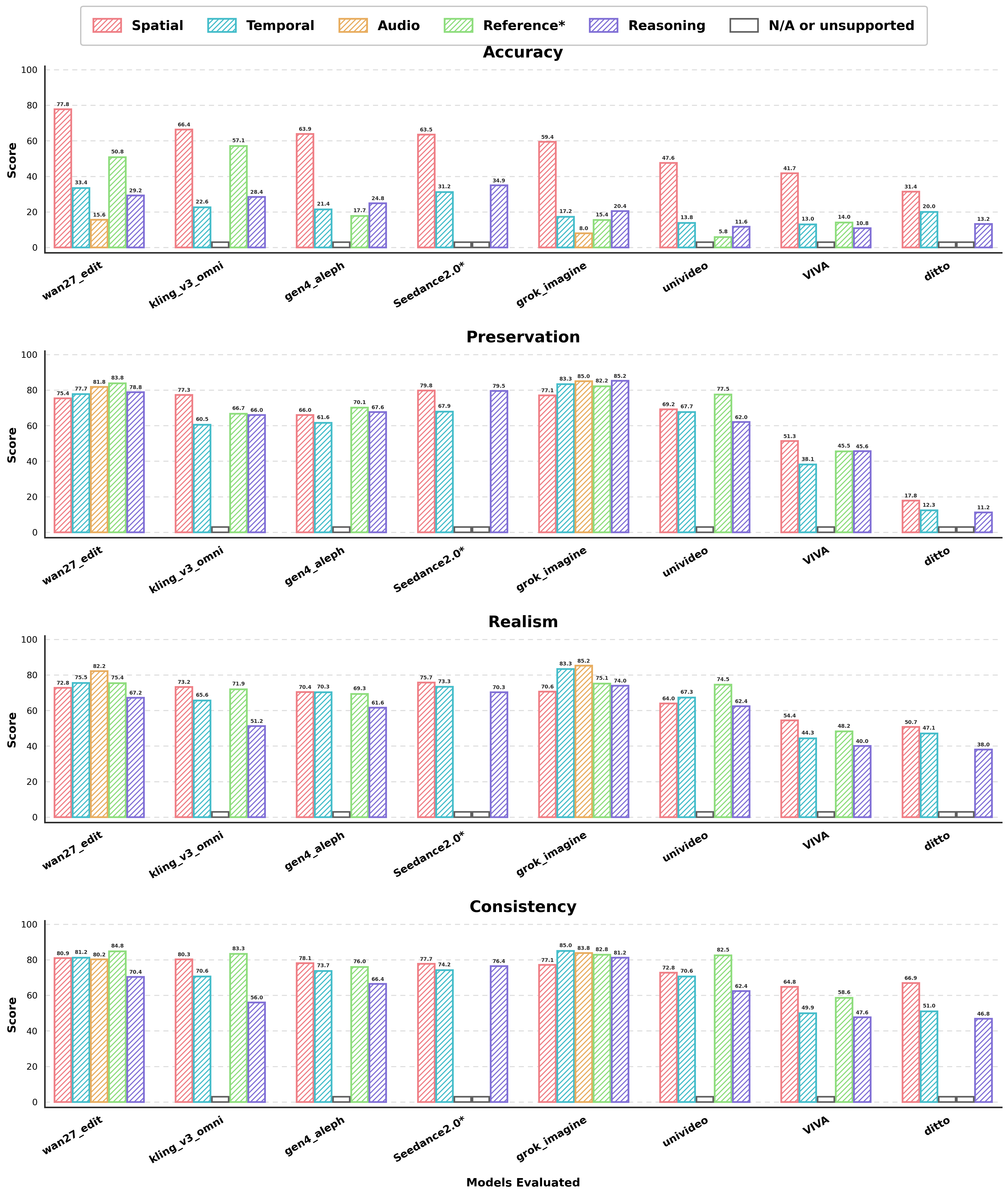
Model comparison
Video examples
Citation
@article{miao2026omnieditbench,
  title   = {OmniEdit-Bench: A Comprehensive Benchmark for Instruction-based Video Editing},
  author  = {Miao, Chenxuan and Feng, Yutong and Lu, Yi and Yan, Yunfeng and Qi, Donglian and Zhang, Shiwei and Liu, Yu and Chen, Xi and Zhao, Hengshuang},
  journal = {arXiv preprint arXiv:2608.05049},
  year    = {2026}
}